Meet Protoje The Strength of Building What You Stand On
Protoje's story is one of visibility converted into authority through design.
Born Oje Ken Ollivierre in Saint Elizabeth, Jamaica, Protoje emerged from a musical foundation where creativity and professionalism already lived side by side. As his own voice developed, he built a sound capable of moving between reggae, hip-hop, soul, and contemporary influences without severing itself from its Jamaican center. His rise was not built around spectacle. It was built around something quieter: intention.
Projects such as Ancient Future expanded that position outward. Collaborations including Who Knows with Chronixx demonstrated how rooted identity could travel globally without being flattened for a larger audience. The music expanded. The center held.
But the more useful story begins beneath the visibility.
Protoje did not simply build an audience around his work. He built structure around it. Through In.Digg.Nation, collaboration, artist development, releases, and ownership-minded growth became part of a larger ecosystem. Artists including Lila Iké, Sevana, and Jaz Elise could grow within a collective framework without disappearing inside someone else's identity. His influence became larger than his own catalog: the structure created room for other artists to stand, too.
As his reach expanded through major stages, Grammy recognition, international media, collaborations, and industry partnerships, the underlying principle remained remarkably consistent. Growth did not have to mean absorption. Partnership did not have to mean surrender. Wider distribution could extend the work while authorship remained connected to the artist and the structure he helped build.
That is what makes Protoje especially interesting for Backstage Blueprint. His career challenges a common assumption about independence: that power comes from doing everything alone. Strategic independence is not isolation. It is having enough structure, ownership, and clarity to enter collaboration from a position rather than from dependency.
For Backstage Blueprint, Protoje's journey asks an essential ownership question: as your visibility grows, are you simply becoming easier to see—or are you building enough structure to decide what happens when opportunity arrives?
What We're Learning From Protoje
The Architecture of Ownership
Visibility creates opportunity. Structure determines who holds the power when it arrives
Choose Your Route
Control how your work enters the world.
Every release travels through a structure. Who controls timing, branding, distribution terms, and the flow of revenue shapes how much authority remains with the artist as the music moves outward.
Own the Orchard
Own what continues producing value.
Songs and recordings are more than release moments—they become part of a body of work that can generate income, opportunity, leverage, and long-term value. Ownership helps keep that compounding value connected to the artist who created it.
Keep the Gate
Keep the relationship within reach.
Platforms can amplify discovery, but they do not give artists permanent control of audience relationships. Websites, email lists, ticketing data, customer relationships, and other owned access points help preserve connection when algorithms or platforms change.
Design the Expansion
Grow without surrendering authority.
Partnership does not have to mean absorption. When rights, duration, ownership, and boundaries are understood, collaboration can extend reach while allowing the artist's underlying structure and identity to remain intact.
Experience Protoje
Watch Independence Become Infrastructure
The audience may grow. The partnerships may expand. Watch what remains in the artist's hands as the structure gets bigger.
Before the Blueprint— Finding Your Voice
Know What You Want to Say
Before building a career around your work, make sure the work sounds like you.
In this early interview, Protoje looks back on the years before the artist audiences would come to know. He had been making hip-hop and recording at home, but one revealing moment came while listening to his music in his mother's car. He kept turning the volume down, embarrassed by what he was hearing. His mother challenged him to find his own true voice if he truly wanted to succeed.
Protoje stepped away from pursuing music publicly for a few years in the early 2000's—but he did not stop creating. He used that period to develop, experiment, and become clearer about his message and how he wanted to sound. When he returned, the foundation of the Protoje identity audiences recognize today had begun to take shape.
His advice to developing artists grows naturally from that experience: know who you are and know what you want to say. Before reach, partnerships, infrastructure, or ownership can strengthen a career, the artist needs a center strong enough for those things to build around.
Watch what happens when two distinct artistic identities meet without either one disappearing.
In Who Knows, Protoje and Chronixx bring two recognizable voices into the same work. The collaboration expands the reach of both artists, but it does not require either one to surrender the identity, message, or cultural grounding that made the partnership meaningful in the first place.
For this lesson, look beyond the success of the song itself. Collaboration can introduce artists to new audiences, strengthen credibility, and create opportunities neither may have reached in quite the same way alone. But its value depends on alignment. The strongest collaborations don't erase distinction—they create something larger from it.
Now look beneath the finished work at the relationships that helped make it possible.
In this conversation, Protoje and Chronixx trace their connection back before Who Knows. Chronixx recalls Protoje bringing artists together, including a meeting involving Kabaka Pyramid and others in their creative community. What eventually became a visible collaboration began with something less visible: initiative, conversation, mutual respect, and sustained relationship-building.
Their reflections also complicate the usual idea of networking as one person trying to gain access to another. Chronixx speaks about the influence Protoje and his work—including the example of his band, The Indiggnation—had on him. Their relationship developed through shared creative space and continued exchange rather than a single transactional opportunity.
For emerging artists, that distinction matters. Community can become part of career infrastructure long before anyone calls it business. Reaching out, bringing people together, learning from peers, sharing ideas, and maintaining genuine relationships can create the conditions from which future collaboration grows.
Watch what changes when independence becomes large enough to enter partnership.
By 2020, the structure around Protoje's work had grown beyond his individual career. In.Digg.Nation Collective—the label and artist management company he founded, and home to Lila Iké and Sevana—entered a multi-album partnership with Six Course/RCA Records. The arrangement created access to greater distribution and industry resources while allowing the collective to move forward through an entity Protoje had already helped build.
That distinction matters. This was not simply another milestone in one artist's rise. The opportunity extended through an existing structure and created room for other artists within it. The career had begun producing infrastructure capable of carrying more than one voice.
For this lesson, notice the sequence. Protoje built artistic identity, relationships, collaborations, and community before larger institutional partnership arrived. Expansion did not have to begin by dismantling what already existed. It could begin by asking how a larger partner might extend it.
The Deal Beneath the Growth — Negotiating From a Position
Expansion Doesn't Require Surrender
A larger opportunity changes the scale. The terms determine what happens to the foundation.
The partnership announcement showed In.Digg.Nation entering a larger industry structure. In this deeper conversation with The FADER, Protoje provides something more useful for artists studying the business behind that growth: insight into how he approached the opportunity itself.
The opportunity developed into an arrangement that brought Protoje's In.Digg.Nation label—and its artists—into the RCA/Six Course partnership while emphasizing creative control, autonomy, and ownership of their masters. Protoje discusses the importance of creative autonomy, ownership, negotiation, and having people around him—including his mother—who understood that proposed terms were not necessarily final terms.
That is the lesson beneath the milestone. Strategic independence does not require refusing every larger opportunity. It requires understanding what you have already built, knowing what matters enough to protect, and entering negotiation from that position.
For emerging artists, the important question is not simply, Who wants to sign me? It is also: What exactly are they asking to participate in—and what am I prepared to keep?
The Structure Evolves — Partnership Without Disappearing
Ownership Is Not a One-Time Decision
The partner may change. The principle underneath the partnership does not have to.
Years after In.Digg.Nation's expansion through Six Course/RCA, Protoje's business structure had evolved again. In this later conversation, he is careful about the language used to describe his relationship with Ineffable. Rather than saying he is “on” Ineffable Records, Protoje explains that he and In.Digg.Nation have a partnership with Ineffable through which the music is released. He describes himself as independent again after the RCA arrangement, while still choosing a partner that can help release and support the music effectively.
That distinction offers artists a useful way to think about independence. Independence does not necessarily mean remaining outside larger systems. It can mean building enough structure, ownership, and clarity to decide how your structure connects with theirs—and being willing to reconsider those arrangements as circumstances change.
For this lesson, notice that the architecture of a career is not finished when the first major agreement is signed. Partnerships change. Markets change. Needs change. Strategic ownership means continuing to understand what you control, what a partner contributes, and whether the arrangement still serves what you are building.
At We Feet — Collaboration From a Stronger Position
The Structure Returns to the Work
After studying the business beneath the career, come back to what the structure exists to support: the music.
Years after Who Knows demonstrated the possibilities of aligned collaboration, Protoje joins Damian “Jr. Gong” Marley for At We Feet, their first recorded collaboration. For Protoje, the moment carried particular meaning: he has described Damian as a major influence and collaborating with him as a longtime artistic goal.
But notice how the collaboration came together. Rather than simply placing Damian on an existing track, Protoje and producer Winta James returned to the creative process after discussing what the two artists could make together. The resulting song centers faith, gratitude, simplicity, and trust—ideas Protoje describes as grounding even when circumstances are uncertain.
For this lesson, the business story matters too. After tracing In.Digg.Nation's growth, negotiations, and changing partnerships, we arrive at a current release issued through In.Digg.Nation Collective under exclusive license to Ineffable Records. The infrastructure has evolved, but its purpose remains visible: to support the artist, the work, and collaborations worth building toward.
After the deals, partnerships, and expansion, the artist still has to stand behind the work.
In this 2026 Podium ZWART performance, Protoje brings different eras of his career into the same room. The set moves through newer work including At We Feet and In Your Corner alongside songs such as Rasta Love and Who Knows—allowing audiences to hear the continuity between the artist who built his early position and the artist working within a much larger structure today.
That continuity matters to this lesson. Ownership, partnerships, collaboration, and infrastructure are not the creative destination. They are meant to create conditions in which the artist can keep making, performing, evolving, and carrying earlier work forward rather than becoming disconnected from it.
Notice what has changed across the career we've just traced—and what has not. The scale is larger. The relationships are broader. The business architecture has evolved. But the music still carries recognizable threads of reggae, hip-hop, soul, and the artistic identity Protoje spent years learning how to inhabit.
Look for: continuity • artistic evolution • live craft • catalog value • structure supporting longevity
The Network Beneath the Career — Relationships That Last
Independence Was Never Isolation
After tracing the structure, listen to Protoje describe the relationships running through it.
In this recent conversation, Protoje reflects on a career now large enough to include international touring, an evolving label structure, a deep catalog, and collaborations across generations. Yet when the discussion turns to relationships, his description of success becomes strikingly human. His connection with Chronixx, for example, developed less through scheduled studio work than through years of conversation, shared ideas, food, friendship, and mutual respect.
Protoje describes their influence as reciprocal: Chronixx inspires him, and he knows he has inspired Chronixx. He also explains that his collaborations are intentional rather than random—sometimes recognizing that a particular voice, perspective, or energy belongs on a specific piece of music. The relationship comes before the transaction; the collaboration grows from artistic alignment.
The conversation also returns to the wider network surrounding a sustainable career. Protoje acknowledges people who supported his music before his name reached the top of festival bills and recognizes their role in the journey. Ownership can protect the foundation, but relationships help a career move through the world. Independence is strongest when artists know what is theirs without believing they have to build everything alone.
Protoje is featured in Chapter Six of The Art of Music Business (Reggae Edition): Branding & Storytelling, where his journey expands the idea of independence beyond simply owning your work. Ownership creates a foundation—but what an artist builds from that foundation determines how far the work can travel without losing its center.
Through Protoje, the chapter explores how artists can make intentional choices about distribution, collaboration, audience access, partnerships, and the assets they create along the way. Independence does not require isolation. It requires understanding what you own, what you control, what you are willing to share, and where partnership can add strength without replacing the structure underneath you.
The lesson also asks artists to think beyond individual opportunities. Relationships can become networks. Catalogs can become assets. Audiences can become communities. Creative careers can grow into structures capable of supporting future work—and sometimes other artists as well.
If opportunity expanded around your work tomorrow, would you be entering it from a position you built—or depending on someone else's structure to hold you?
Proceeds from The Art of Music Business support Backstage Blueprint's mission and artist-education work.
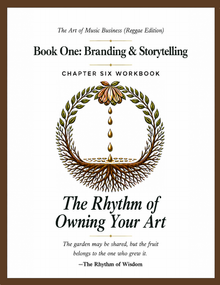
The Rhythm of Owning Your Art – Chapter Six Workbook
A companion workbook to The Art of Music Business (Reggae Edition): Book One — Branding & Storytelling, this guided workbook explores how artists build sustainable careers through ownership, infrastructure, audience access, and intentional control over their creative work.
Inspired by the disciplined independence, narrative control, and structural awareness of Protoje, this workbook encourages artists to examine where their power actually lives — not only in visibility, but in the systems supporting their music, partnerships, catalog, and long-term growth.
The Rhythm of Owning Your Art is not about control rooted in ego. It is about clarity, stewardship, and understanding how ownership protects the ability to move intentionally through a creative career without surrendering authority over the work being built.
Examine ownership, catalog control, and release structure
Explore audience access and platform dependency
Analyze partnerships, leverage, and long-term sustainability
Reflect on where their current systems create strength or vulnerability
Build a personalized Ownership Blueprint for releases, assets, and expansion
Develop practical strategies for protecting music, rights, revenue, and infrastructure
Featuring research assignments, reflective journaling, ownership mapping exercises, structural audits,and protection checklists, this workbook helps artists move from reactive growth toward intentional and sustainable career architecture.
Designed as both a reflective and practical companion resource, this workbook supports independent artists seeking stronger creative control, clearer infrastructure, and greater long-term authority over their work and future.




 PDF
PDF